
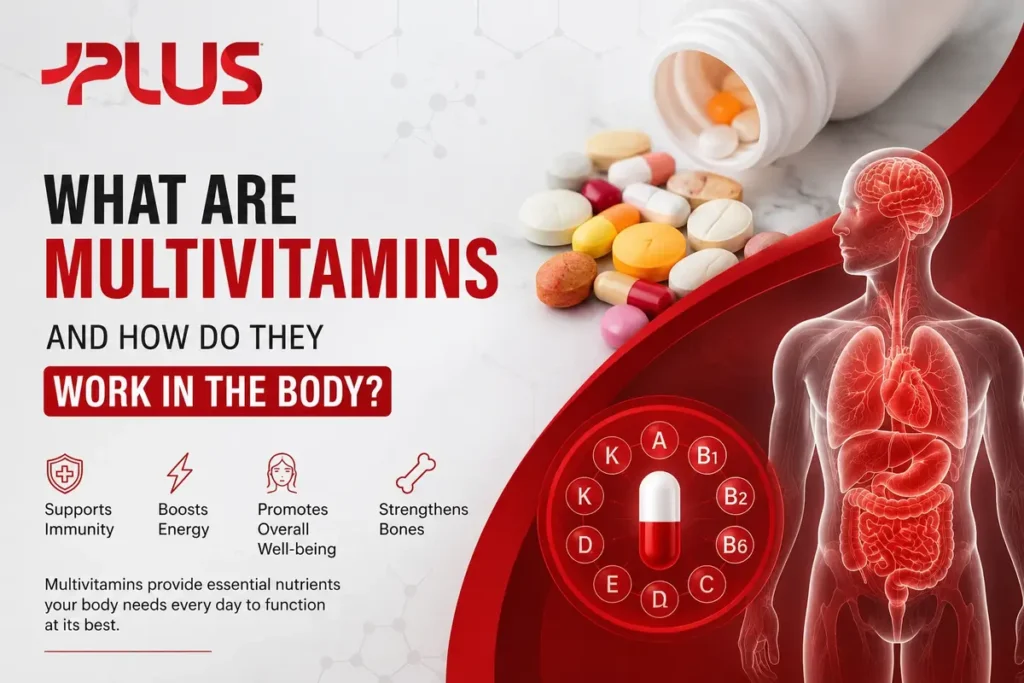
Multivitamins are dietary supplements that combine essential vitamins and minerals into a single daily dose to fill the nutritional gaps your regular diet leaves behind. They work by supplying micronutrients your body uses to produce energy, strengthen immunity, build bones, and carry out hundreds of chemical reactions that keep you functioning every day. If your meals regularly lack variety heavy on roti, rice, and dal but light on fruits, vegetables, dairy, and protein a good multivitamin can meaningfully support your daily health. To maximize these benefits, it’s also important to understand the best time to take multivitamins for better absorption and effectiveness.
A multivitamin is not a medicine. It is a supplement delivering a combination of the 13 essential vitamins and key minerals your body cannot make on its own. A quality formula typically includes vitamins A, C, D, E, K, all eight B vitamins, and minerals like calcium, iron, zinc, magnesium, and iodine.
Formulations differ based on who they are designed for. A multivitamin for women usually contains higher iron (to replace monthly losses) and folate (critical before and during pregnancy). Supplements for men typically reduce or remove iron and may include extra zinc. A multivitamin with iron is best suited for people with confirmed iron-deficiency anemia not everyone needs added iron.
Every vitamin belongs to one of two groups, and this single fact explains most of how multivitamins behave inside your body:
Fat-Soluble Vitamins — A, D, E, K These dissolve in dietary fat and are stored in your liver and fatty tissues. They build up over time, which means you do not need them every single day but taking too much through supplements can cause toxicity. Always take these with a meal containing some fat for proper absorption.
Water-Soluble Vitamins — B-Complex and Vitamin C These dissolve in water, absorb quickly, and are not stored in significant amounts. Your kidneys flush excess out through urine this is why urine turns bright yellow after B-complex tablets, which is completely harmless. Because they are not stored, they need consistent replenishment through food or supplements.
This is the gap most competitor articles skip entirely. Here is what happens after you swallow a multivitamin tablet:
Step 1 — Dissolution: The tablet breaks apart in your stomach acid, releasing individual nutrients.
Step 2 — Absorption: Nutrients cross the lining of the small intestine into your bloodstream. Fat-soluble vitamins need bile and dietary fat to form absorbable particles. This is why taking your tablet with food not on an empty stomach dramatically improves how much you actually absorb.
Step 3 — Transport: Water-soluble vitamins travel directly through blood to the liver and tissues. Fat-soluble vitamins travel via the lymphatic system before entering circulation.
Step 4 — Activation: Most vitamins are converted into their active coenzyme forms inside cells. They then attach to enzymes and “switch them on” enabling reactions your body cannot perform without them.
Step 5 — Use or Storage: Fat-soluble vitamins are stored in the liver and fat tissue. Excess water-soluble vitamins exit through urine.
Vitamins do not directly give you energy they unlock the reactions that allow your body to produce energy, repair tissue, fight infections, and function normally.
The Most Common Deficiencies and Why They Matter
Despite plentiful sunshine, deficiency is extremely widespread, particularly in women who cover skin and people working indoors. It causes bone pain, muscle weakness, fatigue, and weakened immunity.
Iron-deficiency anemia is one of the most prevalent nutritional problems, especially in women and children. The signs iron pills are working include reduced fatigue, better concentration, improved skin colour, and less breathlessness usually noticeable within 3 to 4 weeks.
Known commonly as AD Folic tablets, folic acid tablet uses include preventing neural tube defects in pregnancy, treating megaloblastic anemia, and supporting healthy cell division. Women planning pregnancy should start taking it at least 3 months before conception.
Critical for immunity, wound healing, and growth in children. Deficiency leads to frequent infections, slow recovery, hair loss, and poor appetite.
Required for thyroid hormone production. Deficiency causes goiter and metabolic slowdown, still seen in areas where iodized salt use is inconsistent.
Nutrient Interactions
Nutrients work in isolation, some enhance each other, while others compete:
| Works Better Together | Why It Matters |
| Vitamin D + Calcium | D increases calcium absorption by up to 40% |
| Vitamin C + Iron | C converts iron into a more absorbable form |
| Vitamin K2 + Vitamin D | K2 directs calcium into bones, not arteries |
| Folate + Vitamin B12 | Both needed together for red blood cell formation |
| Nutrients That Compete | What Happens |
| Iron vs. Zinc | High iron doses reduce zinc absorption |
| Calcium vs. Magnesium | Excess calcium can block magnesium uptake |
This is why balance in a multivitamin formula matters far more than simply packing in the highest possible doses.
Side Effects and Safety
Multivitamin tablets side effects are uncommon when taken correctly but can include nausea (especially on an empty stomach), constipation from iron-containing formulas, dark stools from iron (harmless), and bright yellow urine from B vitamins (also harmless).
Serious side effects only occur from long-term excessive intake particularly vitamin A toxicity (headaches, liver damage) and vitamin D toxicity (high calcium in blood, kidney strain). Always follow the recommended dose and consult a doctor if you are pregnant, have a medical condition, or take prescription medications.
If your diet is consistently varied and balanced, a daily multivitamin may add little benefit. But if your meals regularly lack fruits, vegetables, dairy, or protein, a once-a-day tablet helps bridge real nutritional gaps.
Take it with your largest meal of the day ideally one containing some fat. This improves absorption of fat-soluble vitamins (A, D, E, K) and reduces the chance of nausea.
No. This is a common confusion. Vitamin C (ascorbic acid) and calcium are entirely different nutrients. Some supplements contain calcium ascorbate a compound that includes both which may cause the mix-up, but their roles in the body are completely separate.
No supplement replaces whole food. Food contains fibre, phytonutrients, and complex compounds no tablet can replicate. A multivitamin supplements your diet it does not substitute it.
Prenatal vitamins specifically formulated for pregnancy are safe and strongly recommended. Avoid standard adult formulas not designed for pregnancy, as some may contain excessive vitamin A (retinol), which is harmful to the fetus in high amounts.
Over 4 to 8 weeks, you may notice improved energy levels, better sleep, stronger nails, reduced hair fall, fewer seasonal illnesses, and improved mood especially if you had an underlying deficiency being corrected.
Multivitamins work by delivering the vitamins and minerals your body needs to run its most essential processes from producing energy and building bone to forming blood cells and defending against illness. They are not a cure or a substitute for real food, but for anyone whose daily diet consistently falls short in key nutrients, the right multivitamin taken correctly with food is a simple, safe, and effective way to support long-term health. Choose a formula suited to your age, gender, and specific needs and give it at least four to eight weeks to show results.
Whatsapp Us